Physical Address
304 North Cardinal St.
Dorchester Center, MA 02124
Physical Address
304 North Cardinal St.
Dorchester Center, MA 02124

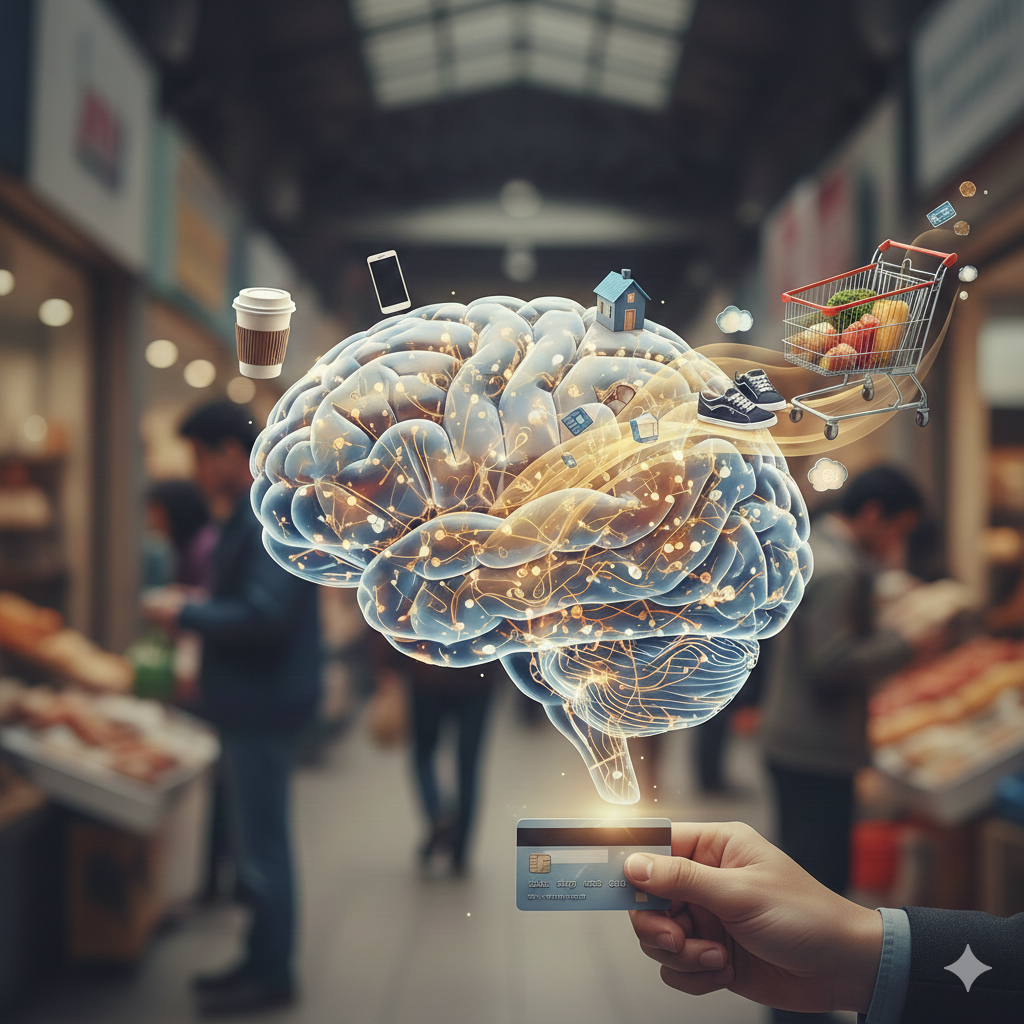
Have you ever gone shopping for “just one thing,” only to walk out with a full bag and a lighter wallet? We’ve all been there. You go in for toothpaste, but somehow, that new scented candle and sleek notebook end up in your cart too. What happened? The truth is, our purchases are rarely about logic alone. They’re about emotions, identity, and the whispers of psychology happening behind the scenes. Every time we shop, a conversation unfolds between our conscious reasoning and our subconscious desires, and most of the time, we don’t even notice it.
The Illusion of Choice
We like to believe we’re in control of our choices. But as Daniel Kahneman reminds us in Thinking, Fast and Slow (2011), our brains rely on two systems: the fast, emotional one that reacts instantly, and the slow, rational one that analyses. The fast system often takes the lead when we shop. That’s why we can feel an instant pull toward something without fully understanding why. Imagine walking into a store that smells of vanilla, and soft music plays in the background. That’s not an accident; it’s sensory marketing. Research shows that scent and sound can unconsciously influence how long we stay in a store and how we perceive products (Krishna, Customer Sense, 2013). In other words, our environment gently nudges our decisions before our rational mind even wakes up.
The Emotional Currency of Brands
Think about your favourite brand. Maybe it’s Apple, Nike, or even a small local coffee shop. Why do you keep going back? It’s not just about product quality. It’s about how that brand makes you feel.
According to Robert Cialdini’s Influence: The Psychology of Persuasion (2007), one of the strongest motivators of human behaviour is liking; we’re more likely to buy from people or brands we like and relate to. Brands know this well; that’s why they craft identities that mirror our aspirations. When Nike says “Just Do It,” it’s not selling shoes; it’s selling courage. When Starbucks writes your name on a cup, it’s not just coffee: it’s belonging.
Every brand becomes a mirror. And every purchase becomes an act of self-expression.
Your customer doesn’t care how much you know until they know how much you care.
Gary Comer
The Trap of “Free” and the Fear of Missing Out
One of the most fascinating parts of consumer psychology is how we perceive value. Behavioural economist Dan Ariely explains in Predictably Irrational (2008) that we often overvalue things labelled as “free.” The word “free” triggers a burst of emotional excitement; it feels like winning, even if the gain is small.
That’s why “Buy One, Get One Free” works so well. We’re not comparing prices rationally; we’re reacting to emotion. Similarly, the fear of missing out (FOMO) pushes us toward limited-time offers. When we see “Only 2 left in stock,” our brain reads it as a social signal of value: if others want it, it must be worth having.
These biases show how deeply our emotions are tied to our perception of money, risk, and reward.
Shopping for Feelings, Not Things
When we buy something, we’re not just purchasing an object; we’re buying how it makes us feel. A new perfume might represent confidence, a planner might symbolise control, and a book might promise self-growth. As behavioural scientist Antonio Damasio explains in Descartes’ Error (1994), emotions are not enemies of reason; they are essential to decision-making.
Marketers who understand this don’t just sell features; they sell feelings. A successful campaign doesn’t say, “This product has X benefits.” It says, “This product helps you become who you want to be.”
That’s why storytelling has become one of the most powerful tools in modern marketing; it connects logic with emotion, bridging what we think with what we feel.
The Moment of Awareness
The beauty of understanding consumer psychology isn’t to manipulate; it’s to become aware. When you know how your brain reacts to colour, music, scarcity, or social proof, you begin to shop more consciously.
The next time you feel drawn to a product, pause for a second and ask: What emotion is this satisfying? Maybe it’s comfort. Maybe it’s identity. Maybe it’s simply joy. Whatever it is, the awareness transforms the act of consumption into something deeper: a reflection of who we are and what we value.